

(Prepared April 2026)
STUDENT ACHIEVEMENT PLAN: ADSB 2024-2025 Academic Year | ||
|---|---|---|
Achievement of Learning Outcomes in Core Academic Skills | Preparation of Students for Future Success | Student Engagement & Well-Being |
Goal: Improve students' literacy learning and achievement | Goal: Improve students' graduation rates and preparedness for future success | Goal: Improve students' participation in class time and learning |
Measure: % of students who met or exceeded the provincial standard on EQAO Assessments for Grade 3/6 Reading and Writing and % of first time eligible students who were successful on the OSSLT/TPCL. | Measure: % of students graduating with an OSSD within five years of starting Grade 9. Includes students who began Grade 9 in 2019-2020 and tracks their progress until 2023-2024. | Measure: % of students in Grades 4-12 who were suspended at least once. |
Measure: % of students who earn 16 or more credits by the end of Grade 10 | Measure: % of students in Grades 1-8 whose individual attendance rate is equal to or greater than 90 percent | |
Goal: Improve students' math learning and achievement | Measure: % of students enrolled in at least one Grade 12 math or Grade 11 or 12 science courses | Goal: Improve student well-being |
Measure: % of students who met or exceeded the provincial standard on EQAO Assessments for Grade 3/6/9 Math | Measure: % of students participating in at least one job skills program (Specialist High Skills Major, Dual Credits or Ontario Youth Apprenticeship Program) | Measure: % of Grade 6, 9 and 10 students who report being aware of mental health supports and services in order to seek supports for mental health
|
Measure: % of students who believe their learning has prepared them for the next step in their learning experience (i.e. next grade, post secondary, etc) | ||
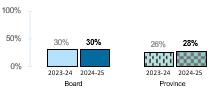
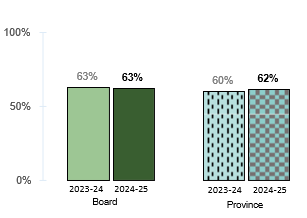
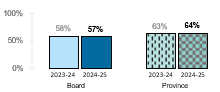
Source: As reported by schools through the Ontario School Information System (OnSIS), 2022-2023 to 2024-2025, and the Education Quality and Accountability Office (EQAO), 2023-2024 to 2024-2025.#N/A: Not applicable. Secondary student indicators are not available for elementary only school boards.
Provincial Priorities | Measures & Results | Actions our School Board will take to Improve | |||
Goal(s) | How this is Measured | School Board Performance | Provincial Performance | Additional School Board Measures /How Our School Board Performs | |
2024-2025 Academic Year / Achievement of Learning Outcomes in Core Academic Skills | |||||
|---|---|---|---|---|---|
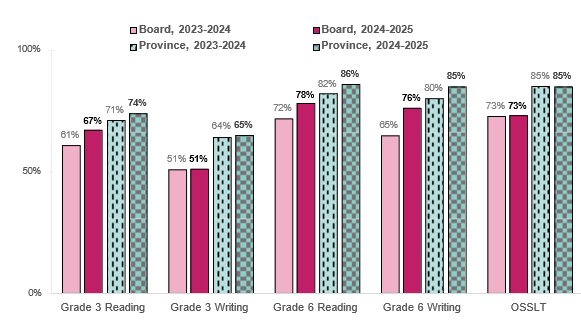
Goal: Improve students' literacy learning and achievement | % of students who meet or exceed the provincial standard on:
Grade 3 EQAO Reading Grade 3 EQAO Writing Grade 6 EQAO Reading Grade 6 EQAO Writing |
67% 51% 78% 76% |
74% 65% 86% 85% | ADSB will continue to gather, review and analyse Board/local student sub-population qualitative and quantitative data to inform this plan and actions for improvement (i.e. Indigenous self-ID data, special education identification, race, gender, sexual orientation, etc.).
| School improvement plans prioritize explicit instruction, accountable talk, and assessment‑informed decision making, guided by school‑level data and implemented through four cycles of continuous improvement. All Kindergarten to Grade 12 teachers develop a Classroom Improvement Plan that uses ongoing classroom assessment data to: -Identify specific instructional strategies responsive to student needs- -Determine professional learning required to support implementation- -Establish methods to measure impact on student learning Tier 1 instruction is supported through evidence‑based tools, programs, and resources, including: Acadience Reading screener, UFLI/The Phonics Companion/Son‑au‑graphe, decodable texts, Bug Club Morphology, Syllasense, literacy and numeracy routines, Knowledgehook, MathUP, concrete and virtual manipulatives. These resources support strong, universal instruction aligned with student learning needs. Classroom teachers, in collaboration with system personnel and multidisciplinary teams, provide targeted small‑group and individualized interventions in response to student assessment data. ADSB tools and programs include: Empower Remedial Reading Program to support decoding, word reading, spelling, vocabulary development, and text comprehension, oral language groups, phonological awareness groups, social language groups, Knowledgehook intervention groups/questions, MathUP parallel tasks. These targeted supports address specific learning needs while strengthening core literacy and numeracy skills. |
% of fully participating, first-time eligible students who are successful on the OSSLT/TPCL | 73% | 85% | |||
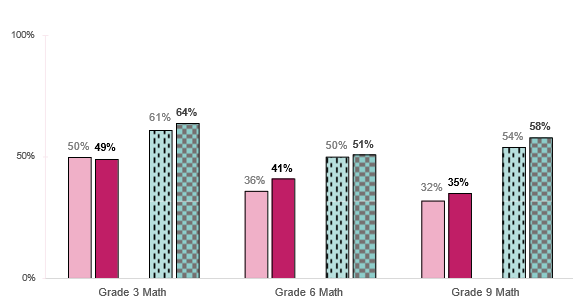
Goal: Improve students' math learning and achievement | % of students who meet or exceed the provincial standard on:
Grade 3 EQAO Math Grade 6 EQAO Math Grade 9 EQAO Math |
49% 41% 35% |
64% 51% 58% | ||
2024 - 2025 Academic Year / Preparation of Students for Future Success | |||||
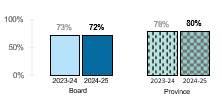
Goal: Improve students' graduation rates and preparedness for future success | % of students who earn 16 or more credits by the end of Grade 10 | 72% | 80% | ADSB will continue to gather, review and analyse Board/local student sub-population qualitative and quantitative data to inform this plan and actions for improvement (i.e. Indigenous self-ID data, special education identification, race, gender, sexual orientation, etc.). | Knowledge and Skills-Based Learning/Programs - leveraging students' interests and aptitudes to develop practical, relevant and responsive programming to support pathways (i.e. Alliance Academy, Outdoor Education, Sparking Secondary Success, SAL, DBT, Rebound North, PLAR) Experiential Learning Opportunities - leveraging students' interests and aptitudes to develop opportunities that are practical, relevant and responsive to promote student engagement. Pathways and Career Planning Tools - providing access to resources and tools (i.e. MyBluePrint, Trades Fair) in supporting students and parents/guardians with education, pathway and career-life planning. Student Success Initiatives - optimizing credit rescue, credit recovery and intervention programs to support credit accumulation. Re-engagement - caring adults supporting academic and non-academic needs to build protective factors, support credit accumulation and promote engagement in pathways and future graduation |
% of students who participated in at least one job skills program (Specialist High Skills Major, Dual Credits or Ontario Youth Apprenticeship Program) | 30% | 28% | |||
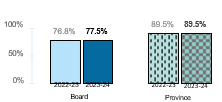
% of students who graduated with an OSSD within five years of starting Grade 9 (2022-2023) | 77.5% | 89.5% | |||
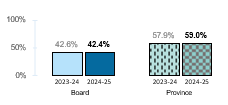
% of students who enrolled in at least one Grade 12 math or Grade 11 or 12 science courses | 42.4% | 59.0% | |||
% of students who believe their learning has prepared them for the next step in their learning experience (i.e. next grade, post secondary, etc) | 57% | 64% | |||
2023-2024 Academic Year / Student Engagement & Well-Being | |||||
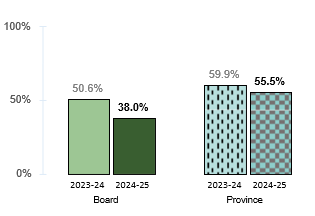
Goal: Improve students' participation in class time and learning | % of students in Grades 1-8 whose individual attendance rate is equal to or greater than 90 percent | 38.0% | 55.5% | ADSB will continue to gather, review and analyse Board/local student sub-population qualitative and quantitative data to inform this plan and actions for improvement (i.e. Indigenous self-ID data, special education identification, race, gender, sexual orientation, etc.). | Professional learning and explicit direction provided to principals, teachers and support staff to implement the ADSB Attendance Procedures Manual, promote communication with families, and ensure attendance is accurate. ADSB System Attendance Lead & Re-Engagement Attendance Coaches to support families and schools in re-engaging persistent non-attending students. Implementation of Coordinated Response Table and other efforts to coordinate Board resources in support of students with multiple suspensions. Review Individual Education Plans, Safety Plans and Behaviour Management Plans with school staff in support of strategies and mitigating behaviours to avoid suspensions. Monthly review of suspension data to understand patterns and inform strategies to reduce suspensions. Reinforce professional learning and resources from School Mental Health Ontario in support of Tier 1 strategies and promoting positive learning environments, and implementation of mental health learning modules in grades 6, 7, 8 and 10. School and Attendance Counselors will participate in individual classroom visits in grade 6, in grade 9 physical and health education classes and grade 10 Careers classes, to further reinforce their role to support positive student mental health, and share pathways to additional student mental health supports. Support parents/guardians in finding pathways to mental health supports in schools and community.
|
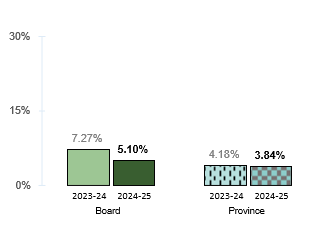
% of students in Grades 4-12 who were suspended at least once | 5.10% | 3.84% | |||
Goal: Improve student well-being | % of Grade 6, 9 and 10 students who report being aware of mental health supports and services in order to seek supports for mental health | 63% | 62% | ||
Source: As reported by schools through the Ontario School Information System (OnSIS), 2022-2023 to 2023-2024, and the Education Quality and Accountability Office (EQAO), 2023-2024 to 2024-2025.#N/A: Not applicable. Secondary student indicators are not available for elementary only school boards.